
- ENERGY CHECK
Accelerating with the foot on the brake
This is how your pump wastes energy
When designing an installation, a pump is often selected with a generous margin, just to be safe. In practice, however, that pump then delivers more than is necessary. The solution is usually found quickly: the valve in the discharge line is closed a little. The flow rate is correct again, and the installation runs.
But the pump continues to run at full capacity. The excess energy is lost in the valve as pressure loss, heat, and wear. It is the same as driving with the accelerator floored and controlling your speed with the brake.
Why this costs so much
Energy is by far the largest cost item over the lifespan of a pump, accounting for up to 85% of the total costs. A pump in the food, dairy, pharmaceutical, or chemical industries often runs day and night. A small waste per hour can add up to a substantial amount per year.
Moreover, a pump that is not operating at its optimal operating point wears out faster. Consider increased vibrations, extra load on bearings and seals, and a shorter service life.
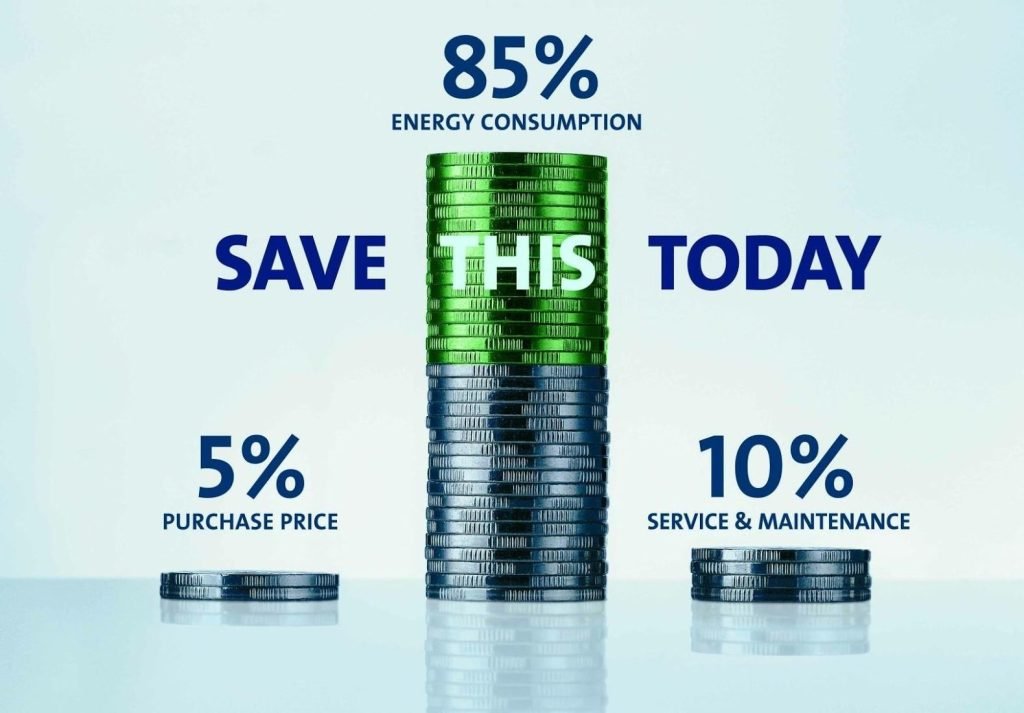
How do you know if your pump is consuming too much energy?
Do you see one or more of these signals in your installation? Then there is a good chance that your pumps are consuming more energy than necessary.
01
Valves that are permanently half-closed
In the pressure line, to regulate flow rate or pressure.
02
Bypass or return lines that are open by default
Through which part of the fluid is pumped around.
03
Pumps that always run at full speed
While the demand varies throughout the day.
04
High pressure before the valve
And a much lower pressure afterwards.
05
More noise, vibrations, or wear
Than you would expect.
What can you do about it?
There are several ways to better match the pump to the installation:
Speed control
With a frequency converter, the pump adjusts its speed to the demand. The power consumption drops sharply at lower speeds, so the savings can be substantial.
Adjust fan
By turning down the impeller, the pump delivers lower head and consumes less energy.
A better-fitting pump
Often, replacement with a smaller or more efficient pump is the best choice. The payback period is then often shorter than expected.

- TO ASK?
The energy check: insight per pump
With Inventflow's energy check, we map the energy consumption of your pumps in accordance with the ISO 14414 standard. We examine, among other things, the pump specifications, motor power, operating hours, and operating point. Contact us for more information.